> For the complete documentation index, see [llms.txt](https://documentation.nomos-system.com/nomos-system/llms.txt). Markdown versions of documentation pages are available by appending `.md` to page URLs; this page is available as [Markdown](https://documentation.nomos-system.com/nomos-system/integrator-en/skills/mqtt.md).
# MQTT
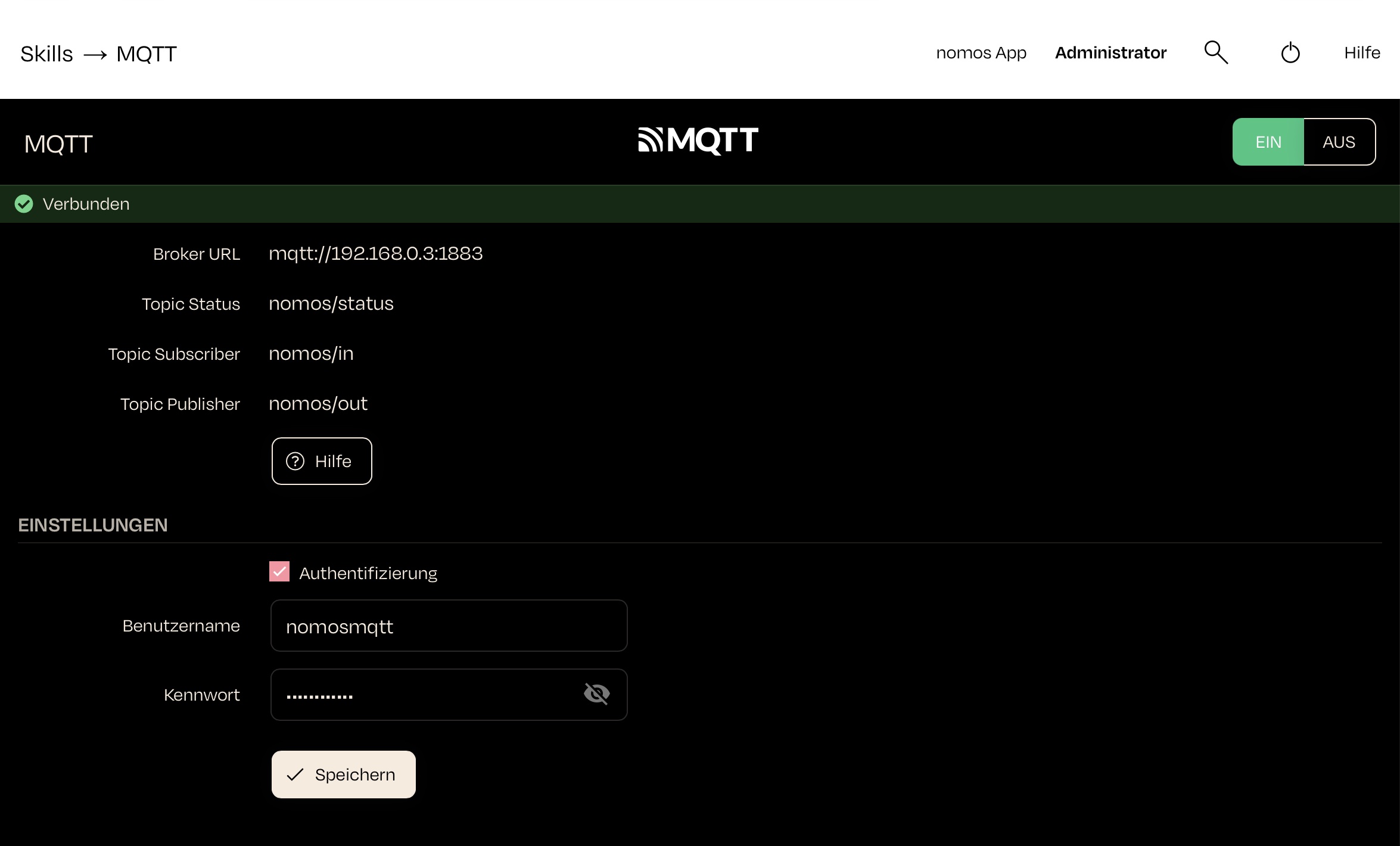
Here you can find the MQTT page within the nomos system Controller, showing the status of the built-in MQTT broker and letting you configure authentication for your own MQTT clients.
1. **Status:**
* **Broker URL:** Displays the address to point your own MQTT client at, i.e. the controller's address in the network (e.g., mqtt://192.168.0.199:1883).
* **Status:** Shows the connection status of the broker..
* **Topic Status:** Displays the status of the assigned topics (message channels).
* **Topic Subscriber:** Number and details of clients receiving messages from a specific topic.
* **Topic Publisher:** Number and details of clients sending messages to a specific topic.
2. **Help:**
* Clicking on the **help** button provides assistance with configuration or issues regarding the MQTT connection.
3. **Settings:**
* **Authentication:** Here you can configure the login your own MQTT client uses to connect to the broker. Leaving it empty allows connections without authentication.
**Usage Notes:**
* **MQTT** is a lightweight messaging protocol specifically optimized for connections with minimal data traffic and low latency. It is widely used in the Smart Home sector to exchange messages between devices.
* The **MQTT broker** acts as a central unit to distribute messages between clients (devices).
* The controller always uses its own built-in MQTT broker; an external broker cannot be configured.
---
# Agent Instructions
This documentation is published with GitBook. GitBook is the documentation platform designed so that both humans and AI agents can read, navigate, and reason over technical content effectively. Learn more at gitbook.com.
## Querying This Documentation
If you need additional information that is not directly available in this page, you can query the documentation dynamically by asking a question.
Perform an HTTP GET request on the current page URL with the `ask` query parameter, and the optional `goal` query parameter:
```
GET https://documentation.nomos-system.com/nomos-system/integrator-en/skills/mqtt.md?ask=&goal=
```
`ask` is the immediate question: it should be specific, self-contained, and written in natural language.
`goal` is optional and describes the broader end goal you are ultimately trying to accomplish on behalf of the user. GitBook uses it to tailor the answer towards what is most useful for that goal.
The response will contain a direct answer to the question and relevant excerpts and sources from the documentation.
Use this mechanism when the answer is not explicitly present in the current page, you need clarification or additional context, or you want to retrieve related documentation sections.