> For the complete documentation index, see [llms.txt](https://documentation.nomos-system.com/nomos-system/llms.txt). Markdown versions of documentation pages are available by appending `.md` to page URLs; this page is available as [Markdown](https://documentation.nomos-system.com/nomos-system/integrator-en/log.md).
# Log
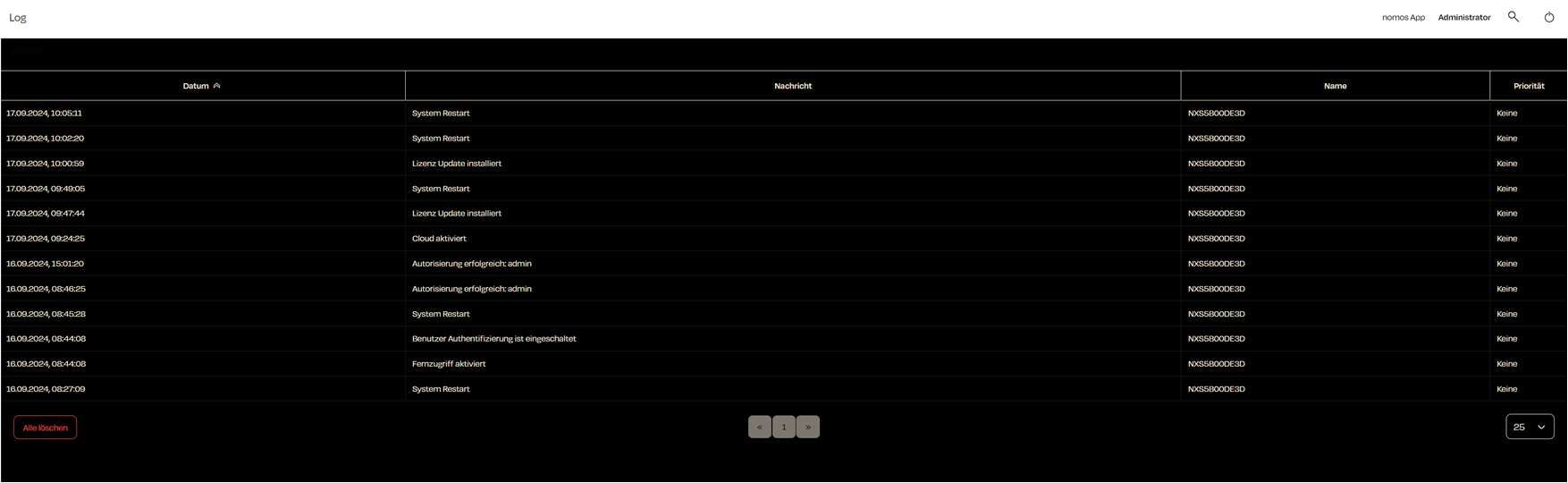
The **log management** feature in the nomos system Controller allows you to monitor all important events, actions, and system processes. This provides an easy way to check the system status, diagnose errors, and track user actions.
## O**verview of Logs**
In the log view, you will see all recorded events. Each row represents an event and contains the following information:
* **Date & Time:** When the event occurred.
* **Message:** A description of the event (e.g., "System Restart", "License Update Installed").
* **Name:** The name of the system or component that triggered the event.
* **Priority:** Indicates the importance of the event (e.g., "None", "Low", "High").
## F**unctionalities**
* **Clear All:** You can clear the entire log by clicking the "Clear All" button. This is useful for simplifying log management and removing old entries that are no longer relevant.
* **Record security events:** Administrators can switch the recording of security events (see below) on and off in the "Security events" section below the table.
## L**og Entries in Detail**
Each log entry provides detailed information about various system processes, such as:
* **System restarts**
* **Installation of updates**
* **Authentication attempts (successful or failed)**
* **Creating, changing and deleting users, and changes to permissions**
* **Activations or deactivations of features like remote access, VPN or cloud connectivity**
* **Restoring a backup, factory reset, migration of a configuration**
* **Pairing and unpairing of management clients**
## Security Events
The system entries listed above are security events: they record who logged in when and which security-relevant changes were made to the nomos system Controller. Their recording is switched on by default, also after a software update and on new controllers.
Administrators can switch the recording off with the "Record security events" checkbox in the "Security events" section below the table, for example when the log is only being used to diagnose devices. Please note:
* While the recording is paused, **no** system entries are written at all, so no logins, no user or permission changes and no update installations.
* Messages from devices and integrations (e.g. Home Connect, Miele, Spotify) are not affected and continue to appear in the log.
* Pausing and resuming are logged themselves ("Security event recording disabled" and "Security event recording enabled"), so the gap in the log remains traceable.
* Ticking the checkbox again resumes the recording. Existing entries are kept in both cases; they are only removed via "Clear All".
We recommend leaving the recording switched on. The log is the simplest way to spot unauthorised login attempts or unexpected changes to users and permissions.
---
# Agent Instructions
This documentation is published with GitBook. GitBook is the documentation platform designed so that both humans and AI agents can read, navigate, and reason over technical content effectively. Learn more at gitbook.com.
## Querying This Documentation
If you need additional information that is not directly available in this page, you can query the documentation dynamically by asking a question.
Perform an HTTP GET request on the current page URL with the `ask` query parameter, and the optional `goal` query parameter:
```
GET https://documentation.nomos-system.com/nomos-system/integrator-en/log.md?ask=&goal=
```
`ask` is the immediate question: it should be specific, self-contained, and written in natural language.
`goal` is optional and describes the broader end goal you are ultimately trying to accomplish on behalf of the user. GitBook uses it to tailor the answer towards what is most useful for that goal.
The response will contain a direct answer to the question and relevant excerpts and sources from the documentation.
Use this mechanism when the answer is not explicitly present in the current page, you need clarification or additional context, or you want to retrieve related documentation sections.