# Users

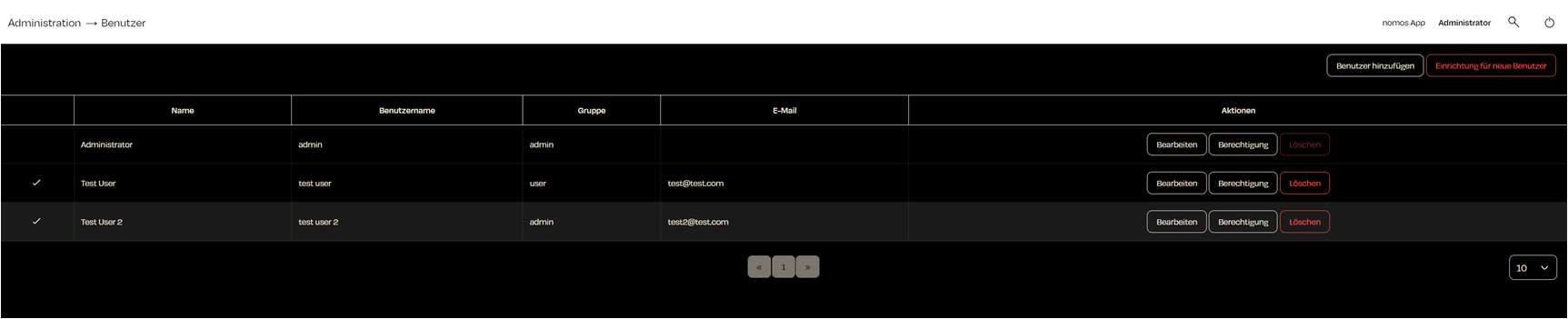
In user management, you can manage user accounts, set permissions, and add new users.

1. **User Overview**
   * **Full Name:** The full name of the user.
   * **Username:** The username for logging in.
   * **Group:** The role of the user, such as "admin" or "user".
   * **E-Mail**: The user's email address for notifications.
2. **Actions**
   * **Edit:** You can change the details of a user, such as their name, email, or username.
   * **Permission:** Here, you can set what permissions the user has within the app.
   * **Delete:** Remove the user from the system.
3. **Add User**
   * By clicking "**Add User**", you can create a new user account. A form will open where you need to enter basic information like name, username, group, and email address.
4. **Setup for new Users**
   * This option allows you to create or change templates for new users. This way, you can predefine settings and permissions for newly created accounts.
5. **Group Membership**
   * The group membership determines a user's rights in the system. A user in the "admin" group has access to administrative functions, while a "user" has limited rights and can only use certain functions.
6. **Permissions**

   The permission settings allow you to individually specify which areas and functions a user can access. The configuration is divided into three tabs:

   #### Tab: Functions

   Here you define which system functions the user has access to. These include:

   * Node-RED, Rooms, Zones, Devices, Scenes, Schedules, Automations, Cloud, Matter/HAP, Settings, Push Notifications, Remote Access, and Background Image Upload

   Each function can be set to one of the following permission levels:

   | Level           | Description                                                            |
   | --------------- | ---------------------------------------------------------------------- |
   | **Full Access** | The user can fully use and control the function.                       |
   | **Off**         | The user has no access to this function. It is not displayed for them. |

   #### Tab: Rooms

   Here you control access to individual rooms. Rooms are displayed grouped by zones (e.g., Ground Floor, Upper Floor). Each room can be assigned an individual permission level:

   | Level           | Description                                                       |
   | --------------- | ----------------------------------------------------------------- |
   | **Full Access** | The user can see and control all devices in the room.             |
   | **View Only**   | The user can see the devices in the room but cannot control them. |
   | **Off**         | The room is not displayed for the user.                           |

   #### Tab: Scenes

   Here you define which scenes the user has access to. Each scene can be configured individually:

   | Level           | Description                              |
   | --------------- | ---------------------------------------- |
   | **Full Access** | The user can see and execute the scene.  |
   | **Off**         | The scene is not displayed for the user. |

   <div data-gb-custom-block data-tag="hint" data-style="info" class="hint hint-info"><p>By combining the three tabs, you can control very granularly which parts of the system a user can see and operate. For example, you can create a user who can only see and control specific rooms, or a user who can view scenes but cannot directly control devices.</p></div>

   <figure><img src="/files/6dkiyRhdit1ISDTtcdzD" alt=""><figcaption></figcaption></figure>


---

# Agent Instructions: Querying This Documentation

If you need additional information that is not directly available in this page, you can query the documentation dynamically by asking a question.

Perform an HTTP GET request on the current page URL with the `ask` query parameter:

```
GET https://documentation.nomos-system.com/nomos-system/integrator-en/administration/users.md?ask=<question>
```

The question should be specific, self-contained, and written in natural language.
The response will contain a direct answer to the question and relevant excerpts and sources from the documentation.

Use this mechanism when the answer is not explicitly present in the current page, you need clarification or additional context, or you want to retrieve related documentation sections.
