> For the complete documentation index, see [llms.txt](https://documentation.nomos-system.com/nomos-system/llms.txt). Markdown versions of documentation pages are available by appending `.md` to page URLs; this page is available as [Markdown](https://documentation.nomos-system.com/nomos-system/integrator-en/skills/knx/knx-settings.md).
# KNX Settings
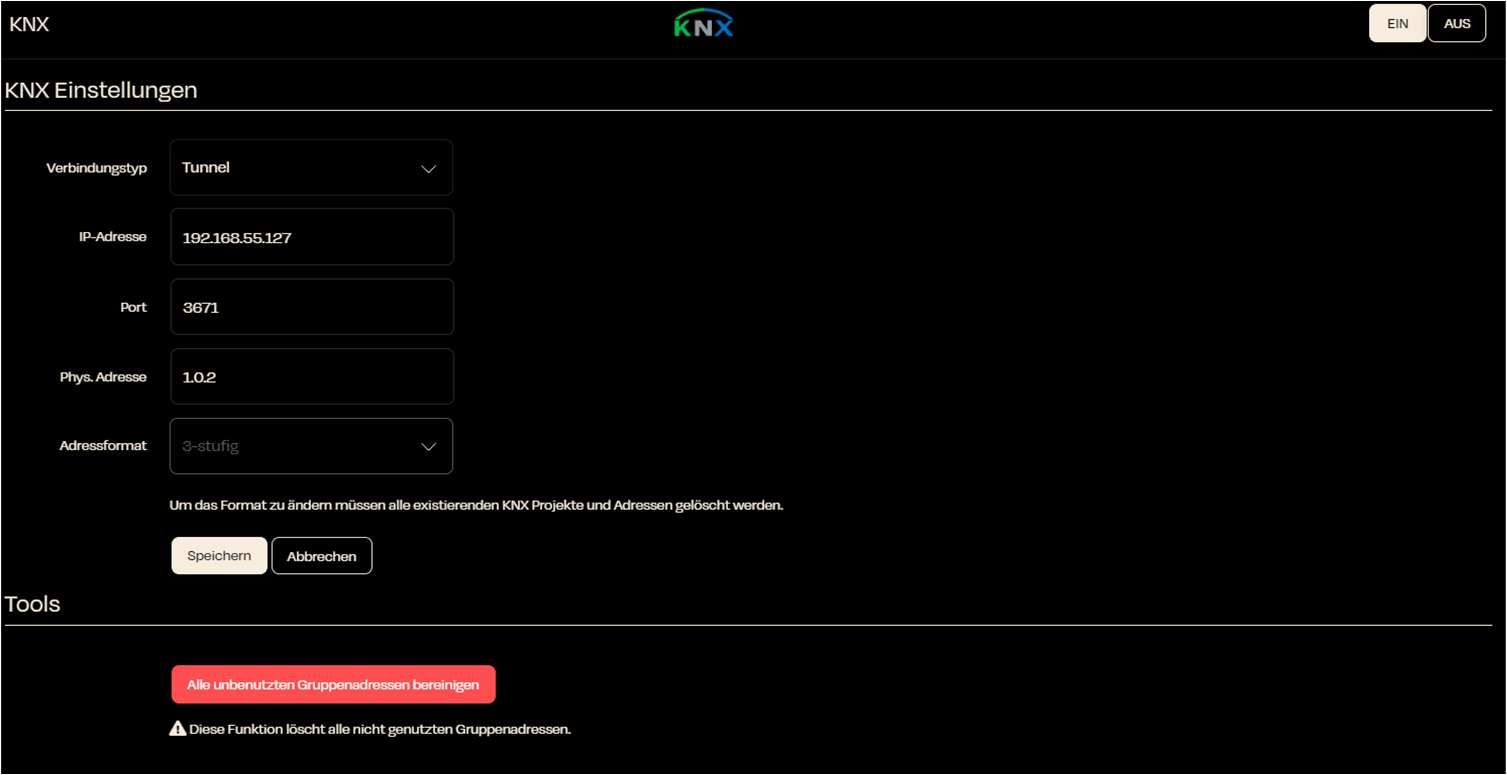
Under **Settings**, you can enter specific KNX network settings. Proper configuration is crucial for the operation of your smart home system.
1. **Connection Type:**
* Pick one of the following modes, depending on the on-site conditions and requirements:
* **Tunneling** — point-to-point connection to a KNX/IP interface or router.
* **Tunneling Secure** — same as Tunneling but encrypted per KNX/IP Secure (AN161). Requires an ETS keyring file (`.knxkeys`) or manual entry of the user password and device authentication code.
* **Routing** — connectionless multicast connection into the KNX backbone, by default via `224.0.23.12`.
* **Routing Secure** — multicast like Routing but encrypted with the backbone key (AN159). An ETS keyring file is mandatory.
* **Tunneling + Routing Bridge** — tunnel connection to the installation plus an additional multicast bridge into the local network (for KNX apps and IP devices that cannot reach the router directly).
2. **Device IP:** (tunneling variants only)
* Input field: IP address of the KNX/IP interface or router. Make sure the address is reachable and on the same subnet as the system.
3. **Multicast IP:** (routing variants only)
* Input field: multicast address of the KNX installation. The default `224.0.23.12` is the common value; only change it if specified by the integrator.
4. **Port:**
* Input field: The port used for KNX communication (`3671`). This is the default port. Change it only if absolutely necessary, and only if you know which port should be set.
5. **Physical Address:**
* Input field: Enter the physical address of the KNX interface in the KNX network here.
6. **Address Format:**
* Selection: The address format used for displaying KNX communication (two- or three-level).
7. **KNX/IP Secure:** (Tunneling Secure and Routing Secure only)
* **Tunnel User ID** (Tunneling Secure only): the tunnel slot to use on the interface/router. Default is `2` — ETS assigns this slot as the first tunnel user automatically. If the installation provides several tunnel slots (e.g. shared with other third-party clients), enter the slot number reserved for Nomos (1–127).
* **From Keyring File:** Recommended approach. Upload the `.knxkeys` file exported from ETS and enter the export password. User password and device authentication code are pulled from the keyring automatically based on the tunnel user ID.
* **Enter manually:** For installations without an ETS export. In addition to the tunnel user ID, enter the **user password** and the **device authentication code**. Manual entry is not available for Routing Secure — the backbone key comes from the keyring only.
8. **Tools:**
* This is where you can delete all unused group addresses. This function is meant to clean up the system from unused data and prevent unnecessary load. Be careful, use this function only when the project integration is complete and all necessary addresses/devices/objects have been set up.
---
# Agent Instructions
This documentation is published with GitBook. GitBook is the documentation platform designed so that both humans and AI agents can read, navigate, and reason over technical content effectively. Learn more at gitbook.com.
## Querying This Documentation
If you need additional information that is not directly available in this page, you can query the documentation dynamically by asking a question.
Perform an HTTP GET request on the current page URL with the `ask` query parameter, and the optional `goal` query parameter:
```
GET https://documentation.nomos-system.com/nomos-system/integrator-en/skills/knx/knx-settings.md?ask=&goal=
```
`ask` is the immediate question: it should be specific, self-contained, and written in natural language.
`goal` is optional and describes the broader end goal you are ultimately trying to accomplish on behalf of the user. GitBook uses it to tailor the answer towards what is most useful for that goal.
The response will contain a direct answer to the question and relevant excerpts and sources from the documentation.
Use this mechanism when the answer is not explicitly present in the current page, you need clarification or additional context, or you want to retrieve related documentation sections.