> For the complete documentation index, see [llms.txt](https://documentation.nomos-system.com/nomos-system/llms.txt). Markdown versions of documentation pages are available by appending `.md` to page URLs; this page is available as [Markdown](https://documentation.nomos-system.com/nomos-system/integrateur-fr/administration/parametres.md).
# Paramètres
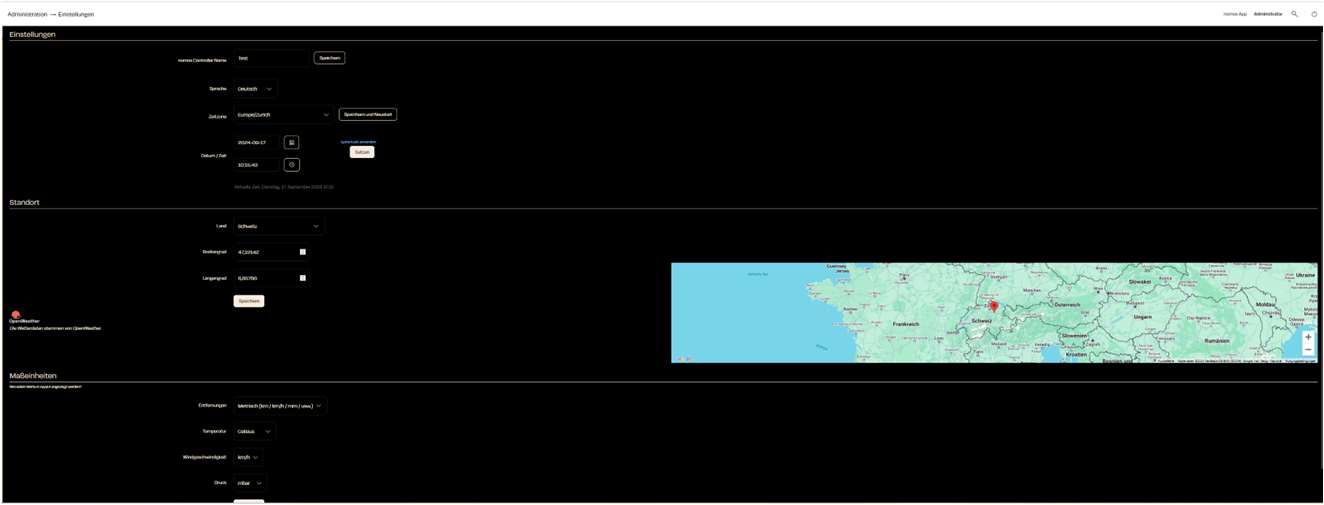
1. **Paramètres**
* **nomos system Controller Nom :** Ici, vous pouvez définir le nom du contrôleur.
* **Langue :** Via le menu déroulant, vous pouvez choisir la langue préférée pour l'interface utilisateur (par exemple, Allemand, Anglais, Français, Néerlandais).
* **Fuseau horaire :** Sélectionnez votre fuseau horaire pour que le contrôleur fonctionne correctement.
* **Date/Heure :** Ici, vous voyez la date et l'heure actuelles. Vous pouvez les régler manuellement si nécessaire.
2. **Localisation**\
La localisation est utilisé pour configurer correctement le service météorologique (OpenWeather) afin d'afficher les données météorologiques.
* **Pays :** Choisissez le pays où se trouve votre contrôleur.
* **Latitude / Longitude :** Entrez les coordonnées géographiques précises pour le lieu du contrôleur afin d'obtenir des informations météorologiques et horaires précises.
3. **Météo**
* **Température extérieure :** Choisissez l'appareil dont la mesure fait office de température extérieure pour le système. Sont proposés les capteurs de température, les stations météo et les pompes à chaleur disposant d'une sonde extérieure. Chaque entrée indique sa pièce, afin de distinguer des sondes portant le même nom. Si **« Prévisions météo »** reste sélectionné, les prévisions pour le lieu défini sous « Localisation » continuent d'être utilisées. Le choix est appliqué immédiatement.
{% hint style="info" %}
**Un appareil manque dans la liste ?** Ne sont proposés que les appareils qui nomment réellement leur sonde extérieure. Certains régulateurs de chauffage numérotent leurs sondes (p. ex. `sensor_temperature_00` à `_15`) ou en ont une par circuit — laquelle se trouve dehors ne ressort pas du profil de l'appareil, seul l'installateur le sait. Ces appareils sont donc écartés plutôt que de proposer une source qui ne livrerait ensuite rien, sans le dire.
{% endhint %}
4. **Unités de mesure**\
Sélectionnez les unités de mesure à utiliser dans l'application et le système.
* **Distance :** Choisissez entre les unités métriques (km/h, km) et impériales (mph, mi).
* **Température :** Décidez si la température doit être affichée en Celsius ou Fahrenheit.
* **Vitesse du vent :** Ici, vous pouvez choisir entre km/h, m/s ou mph.
* **Pression :** Déterminez les unités pour la pression atmosphérique (mbar, hPa, etc.).
5. **Système - Enregistrer et redémarrer**
* Après avoir configuré tous les paramètres, vous pouvez enregistrer les modifications et redémarrer le système pour appliquer les réglages.
---
# Agent Instructions
This documentation is published with GitBook. GitBook is the documentation platform designed so that both humans and AI agents can read, navigate, and reason over technical content effectively. Learn more at gitbook.com.
## Querying This Documentation
If you need additional information that is not directly available in this page, you can query the documentation dynamically by asking a question.
Perform an HTTP GET request on the current page URL with the `ask` query parameter, and the optional `goal` query parameter:
```
GET https://documentation.nomos-system.com/nomos-system/integrateur-fr/administration/parametres.md?ask=&goal=
```
`ask` is the immediate question: it should be specific, self-contained, and written in natural language.
`goal` is optional and describes the broader end goal you are ultimately trying to accomplish on behalf of the user. GitBook uses it to tailor the answer towards what is most useful for that goal.
The response will contain a direct answer to the question and relevant excerpts and sources from the documentation.
Use this mechanism when the answer is not explicitly present in the current page, you need clarification or additional context, or you want to retrieve related documentation sections.