> For the complete documentation index, see [llms.txt](https://documentation.nomos-system.com/nomos-system/llms.txt). Markdown versions of documentation pages are available by appending `.md` to page URLs; this page is available as [Markdown](https://documentation.nomos-system.com/nomos-system/integrator-nl/automatiseringen/trigger-instellen.md).
# Trigger instellen
De **trigger** bepaalt wanneer de automatisering wordt uitgevoerd. Dit kan worden getriggerd door verschillende gebeurtenissen of toestanden, zoals het bereiken van een bepaald tijdstip, een sensor gebeurtenis of een verandering in het weer.
**Stappen om een trigger te kiezen:**
1. **Trigger toevoegen:**
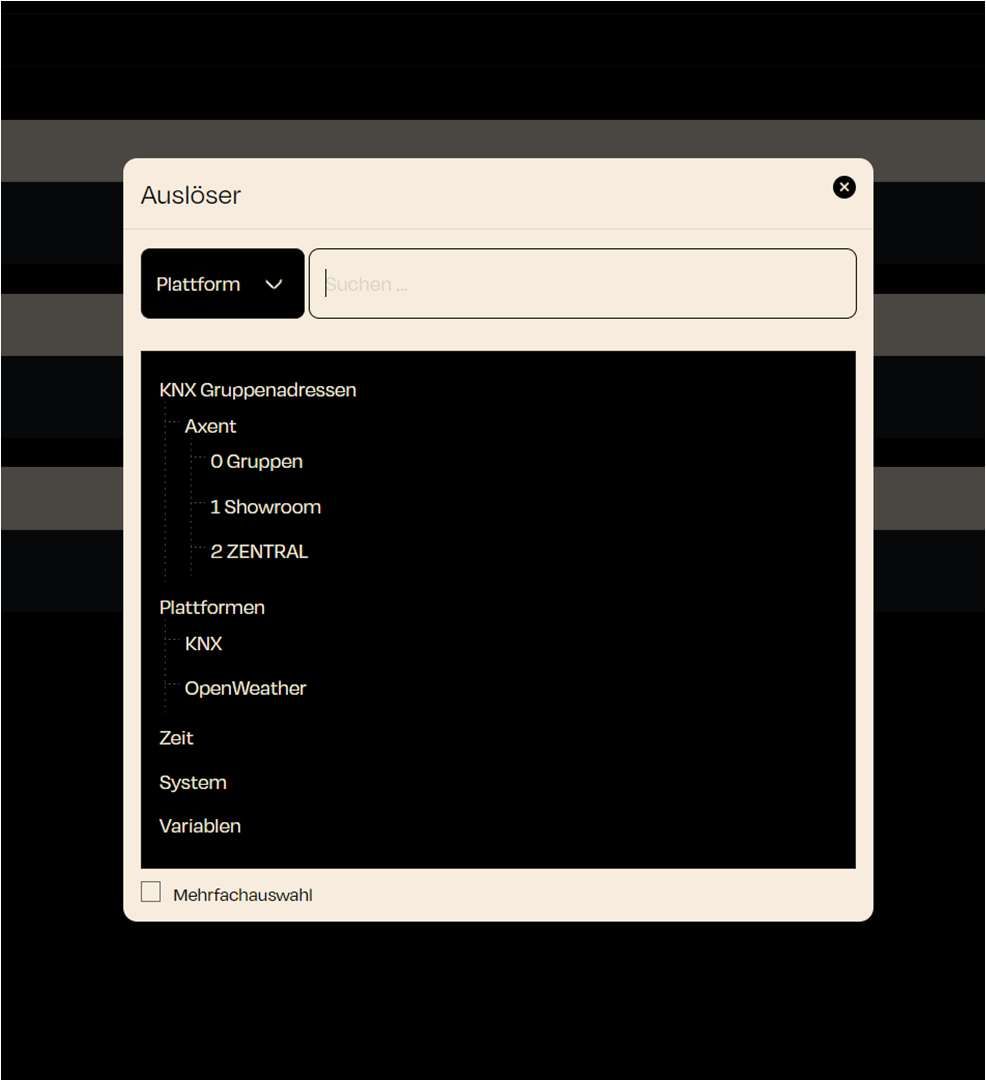
* Klik op "**Maak de eerste trigger**". Er verschijnt een venster waarin u het platform of de gebeurtenis kunt kiezen die de automatisering moet activer
2. **Platform kiezen:**
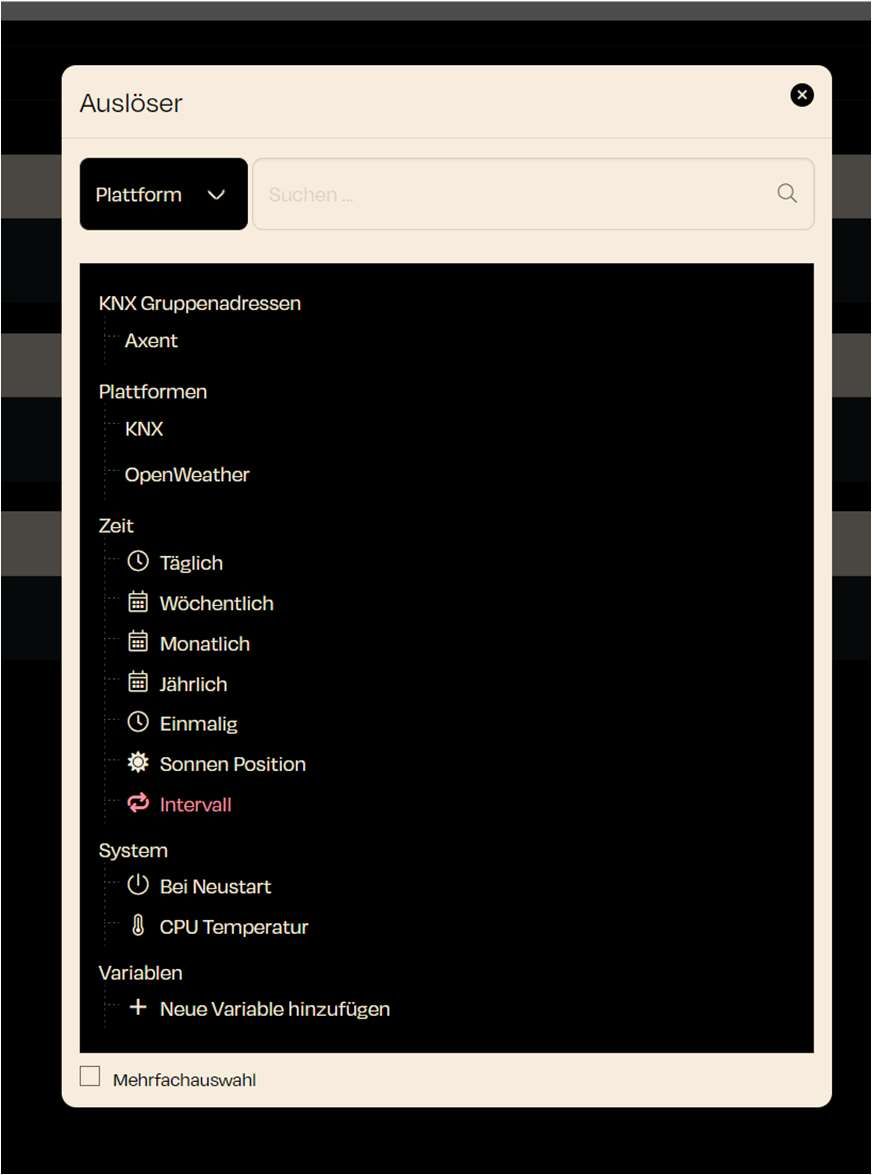
* Kies in het dropdown-menu "**Platform**" het juiste platform of de categorie die de trigger levert.
* Voorbeelden van platforms:
* **KNX**: Hier kunt u toegang krijgen tot KNX-groepsadressen om apparaten of scènes op dit platform als trigger te gebruiken.
* **OpenWeather**: U kunt weersomstandigheden als trigger instellen (bijv. regen, zonsondergang, temperatuurverandering).
* **Systeem:** Systeemgebeurtenissen zoals herstart of shutdown kunnen ook als triggers worden gebruikt.
* **Variabelen:** Wijzigingen in gedefinieerde variabelen van het systeem kunnen ook als triggers dienen.
3. **Meervoudige selectie (optioneel):**
* Als meerdere triggers tegelijk moeten worden geselecteerd, kunt u de optie "**Meervoudige selectie**" inschakelen. Hierdoor kunt u meerdere gebeurtenissen als potentiële triggers definiëren die parallel worden bewaakt.
4. **Zoeken naar triggers:**
* Gebruik het zoekveld om specifieke triggers sneller te vinden, vooral bij grotere installaties of als er veel groepsadressen zijn.
5. **Bevestigen:**
* Nadat u de gewenste trigger hebt gekozen, sluit u het venster om de trigger aan de automatisering toe te voegen.
{% hint style="info" %}
**Opmerking:**
* Triggers zijn de eerste stap van elke automatisering. Ze definiëren wanneer en onder welke omstandigheden een actie wordt uitgevoerd. Door gebruik te maken van verschillende platforms kunt u een verscheidenheid aan gebeurtenissen als triggers gebruiken om het systeem optimaal te automatiseren.
{% endhint %}
---
# Agent Instructions
This documentation is published with GitBook. GitBook is the documentation platform designed so that both humans and AI agents can read, navigate, and reason over technical content effectively. Learn more at gitbook.com.
## Querying This Documentation
If you need additional information that is not directly available in this page, you can query the documentation dynamically by asking a question.
Perform an HTTP GET request on the current page URL with the `ask` query parameter, and the optional `goal` query parameter:
```
GET https://documentation.nomos-system.com/nomos-system/integrator-nl/automatiseringen/trigger-instellen.md?ask=&goal=
```
`ask` is the immediate question: it should be specific, self-contained, and written in natural language.
`goal` is optional and describes the broader end goal you are ultimately trying to accomplish on behalf of the user. GitBook uses it to tailor the answer towards what is most useful for that goal.
The response will contain a direct answer to the question and relevant excerpts and sources from the documentation.
Use this mechanism when the answer is not explicitly present in the current page, you need clarification or additional context, or you want to retrieve related documentation sections.